
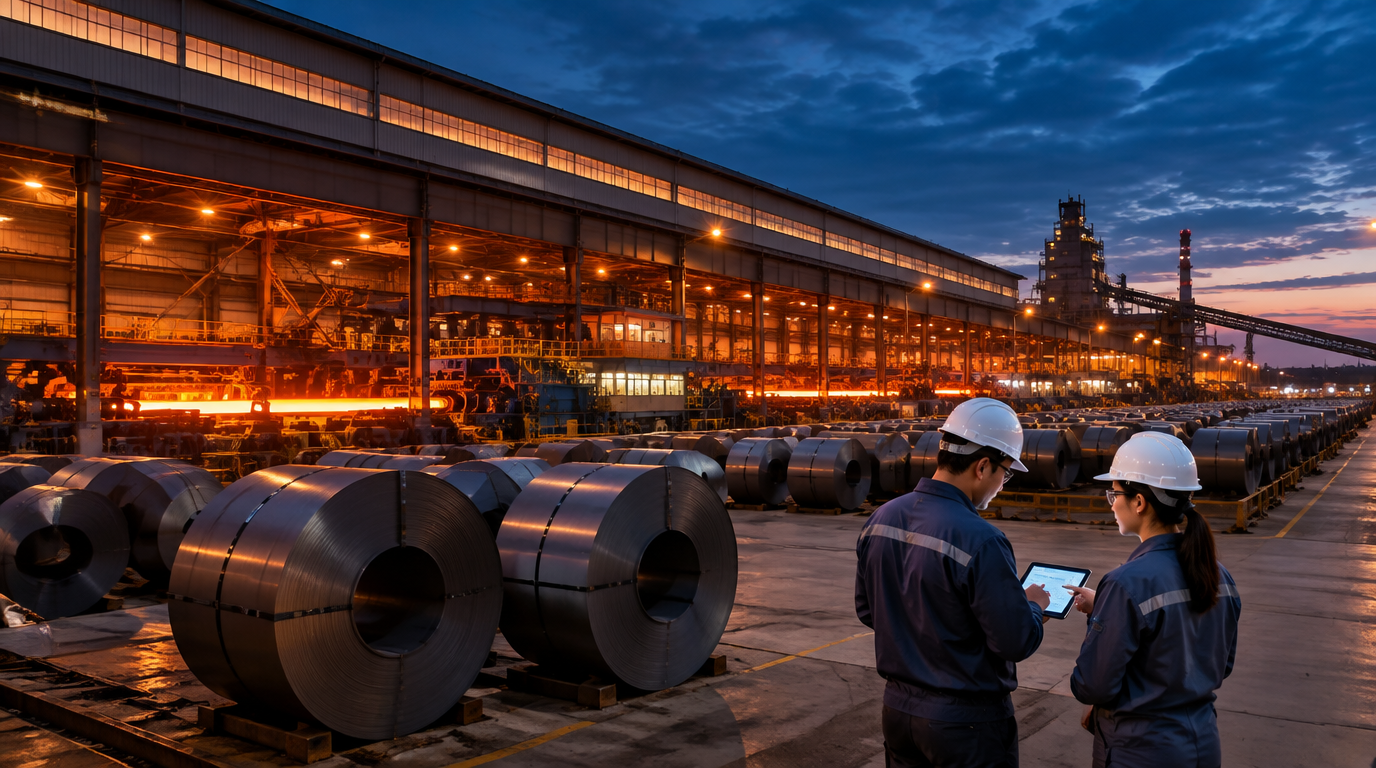
When the largest steelmaker in Vietnam changes course, the smart move is not to applaud. It is to ask what they can see that you cannot. Hoa Phat Group has completed a group-wide greenhouse gas inventory to ISO 14064-1:2018, verified by third-party auditors, and is steering its Dung Quat 2 complex toward low-emission, high-quality steel. This is not public relations. It is preparation for a market where carbon data decides who gets the order.
This piece draws on Hoa Phat’s own announcements and industry reporting, which we credit in the sources below. Our question is the one a managing director of a mid-sized mill, coater or fabricator should ask: if the biggest player in the country is spending real money on this now, what does that mean for the rest of us?
What Hoa Phat actually did
Three moves matter. First, a full greenhouse gas inventory across the group, built to ISO 14064-1:2018 and checked by an external verifier. Second, a public carbon neutrality roadmap to 2050, with named technology directions: direct reduced iron, more renewable energy, higher scrap use and continuous rolling to cut energy per tonne. Third, the Dung Quat 2 expansion, completed with SMS group, is explicitly aimed at high-quality hot-rolled coil for automotive customers and low-carbon steel, with dust emissions under 20 mg/Nm3.
Notice the order. The data came first. Before announcing green steel, Hoa Phat made sure it could measure and prove its emissions at installation level, to a standard EU verifiers recognise. That sequence is the lesson.
Green steel is a headline. Verified emissions data is the entry ticket. Hoa Phat bought the ticket before printing the headline.
Why they are moving before the law forces them
CBAM’s definitive period started on 1 January 2026. EU importers of Vietnamese steel now carry a real certificate cost, and that cost depends on the emissions data the supplier provides. On EU default values, hot-rolled coil from Vietnam costs an importer roughly €103 per tonne in 2026 and around €193 by 2030, as we laid out in our previous article. With verified actual data from an efficient producer, the same tonne can cost half that, or less.
Hoa Phat’s leadership can read that spreadsheet. A producer who hands EU customers verified, low emission values becomes cheaper to buy from without cutting its own price by a single dollar. A producer who cannot is quietly marked up in every buyer’s landed-cost calculation. By 2030, on default values, that mark-up can exceed 35% of the border value. No sales team negotiates its way out of that.
The competitive signal for everyone else
There is a second, quieter signal. When the market leader invests in verified data and low-carbon product lines, it is not only defending its current EU sales. It is building the ability to take share from every Vietnamese competitor who is slower. EU buyers under CBAM pressure will consolidate their supplier lists around mills that make their compliance easy. The first movers in Hanoi, Hai Phong and Ba Ria-Vung Tau will be on those lists. The question is who else will be.
This is how CBAM reshapes a market even before the money gets big: not through Brussels fines, but through purchasing decisions in Düsseldorf, Milan and Warsaw.
What a mid-sized exporter should copy, in order
- 1.
Measure before you market
Start with an installation-level emissions inventory aligned to the EU method. ISO 14064-1 is a solid frame because EU verifiers already know it. Do not announce green ambitions before your numbers survive an audit.
- 2.
Know your cost gap
Calculate what your EU customers pay on default values versus your actual emissions, for 2026, 2028 and 2030. That gap is your business case for every efficiency and data investment.
- 3.
Pick investments that show up in the number
Scrap share, energy efficiency, gas recovery, renewable power: prioritise what moves your verified emissions per tonne, because that is the figure your customer’s finance team sees.
- 4.
Get verification on the calendar early
Accredited verifiers must visit the site, capacity in Vietnam is thin, and the first annual declarations are due by 30 September 2027. Hoa Phat already has its audit trail. Latecomers will queue.
- 5.
Turn data into a sales argument
Once verified, your emissions profile is a commercial asset. Put it in your customer contracts and price discussions: you are saving your buyer real certificate money.
Find out where you stand before your competitor does
Our free CBAM Readiness Assessment shows which of your products are in scope, what default values cost your EU buyers today, and where your data gaps sit. About 15 minutes, with a review by our CBAM team at the end.
Start the free CBAM Readiness AssessmentFurther viewing
For the wider context of how Vietnamese business is reading the green transition, the discussion “Business Readiness in the Global Green Economy” is worth your time alongside the numbers above.
Watch: Business readiness in the global green economy
A regional view of how companies are positioning for the green economy. Use it for orientation, then run the numbers for your own products and installations.
Sources and editorial references
- Hoa Phat Group, “Hoa Phat Group targets green steel development”, September 14, 2023 (hoaphat.com.vn)
- SteelOrbis, “Vietnam’s Hoa Phat completes expansion works at Dung Quat 2”, September 2025
- Vietnam Steel Association conference reporting on Hoa Phat’s green growth roadmap, 2023
- Regulation (EU) 2023/956, as amended by Regulation (EU) 2025/2083 (EUR-Lex)
- Implementing Regulation (EU) 2025/2621 (default values) and 2025/2620 (benchmarks)
- “Business Readiness in the Global Green Economy” (YouTube)
This article is our own analysis. Facts about Hoa Phat Group are drawn from the public sources listed; all rights remain with their owners. Cost figures are illustrative and do not replace a calculation for your installation.

Dr. Elvis Mujagić
Dr. Elvis Mujagić is Partner and Head of CBAM at wis.dom|bridge™. He advises companies on CBAM cost exposure, implementation and the link between carbon data, sourcing and financial planning.