
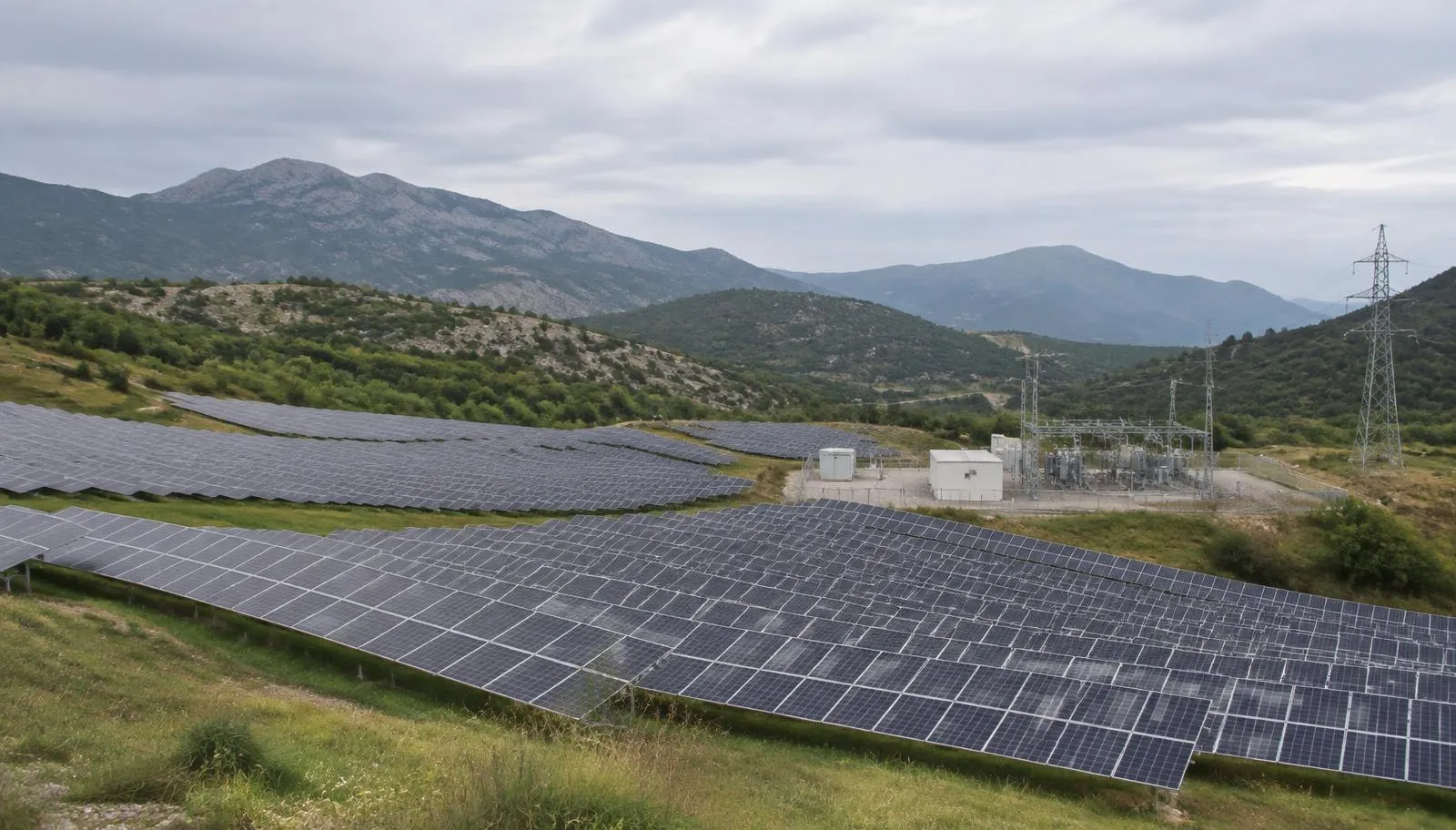
For years, a renewable project in the Western Balkans was financed on a familiar set of numbers: sun or wind resource, CAPEX, wholesale prices, grid access and balancing costs. If the project plans to sell power into the EU, lenders now need one more answer. Can the project prove, under CBAM rules, that the electricity it delivers is actually low-carbon?
Electricity is one of the goods covered by the EU Carbon Border Adjustment Mechanism. When power crosses into the EU, the authorised CBAM declarant has to account for its embedded emissions. If actual emissions cannot be demonstrated, the declarant falls back on a default value, and for most of the region that default reflects a coal-heavy grid.
That creates an uncomfortable situation. A clean solar park can be treated, on paper, like a coal plant. Not because it emits, but because nobody can prove that it does not.
Green electricity without verifiable evidence can be priced as if it came from the dirtiest part of the grid.
Why this becomes a bank question
A lender finances future cash flows. If an EU buyer has to pay a CBAM charge on every MWh because the evidence is missing, that cost does not disappear. It is pushed back into the price the buyer is willing to pay, into contract renegotiations, or into lost buyers. Either way, it reaches the project revenue line and the debt service cover ratio.
As reported by CBAM.news, lenders will therefore need to look beyond the technical project and ask whether its route to market can preserve its low-carbon value under the CBAM method. That is not an ESG side topic. It is credit risk.
Same technology, very different exposure
The striking point is how much the risk depends on location. The national default emission factors differ sharply across the region, so the cost of failing to prove actual emissions differs as well.
- 1.
Albania
Albania currently has a zero default factor because its power comes mostly from hydro. A project that cannot demonstrate actual emissions faces little exposure through the national default, at least under the current values.
- 2.
Bosnia and Herzegovina
For a Bosnian project, the same failure could leave the EU buyer facing almost EUR 95 per MWh in CBAM costs at the Q3 certificate price. That is in the range of, or above, the wholesale value of the electricity itself.
- 3.
Serbia and Montenegro
Here, the corresponding exposure is already above EUR 80 per MWh. Again, enough to wipe out the commercial logic of an export contract.
Two technically identical solar parks, a few hundred kilometres apart, can therefore carry completely different bankability profiles. The panels are the same. The evidence chain and the grid they sit in are not.
In Bosnia, Serbia or Montenegro, missing CBAM evidence can cost more per MWh than the power is worth.
What lenders will start to check
Due diligence will extend from the plant to the paper trail behind each delivered MWh. Expect questions in these areas:
- PPA structure: who carries the CBAM cost, how the low-carbon attribute is defined, and what happens if evidence fails.
- Metering systems: certified, time-stamped generation data that can be matched to exported volumes.
- SCADA records: complete, stored and accessible operational data, not only monthly summaries.
- Trading arrangements: how the power physically and contractually moves to the EU, including any intermediaries.
- Nomination evidence: proof that the cross-border capacity was nominated for the specific power being claimed.
- Verifier access: whether an accredited verifier can actually reach the site, systems and records.
- The EU CBAM declarant: who it is, whether it is authorised, and whether it will accept the project data.
Note what is missing from this list. Guarantees of Origin on their own do not answer the CBAM question. They remain a separate instrument, and lenders should not treat them as a substitute for CBAM evidence.
Where projects typically fall short
In our work with producers and exporters, the problem is rarely the technology. It is that nobody owns the evidence chain from end to end.
- The PPA was signed before CBAM was understood, so it is silent on who pays when evidence is missing.
- Metering and SCADA data exist, but are held by the O&M contractor and cannot be handed to a verifier on request.
- The trader handles nominations, but the project has no copy and no contractual right to the records.
- Nobody has identified which EU entity will act as the CBAM declarant, or asked what data it needs.
- The financial model assumes green power is automatically worth a green price.
What developers should do now
The good news: most of this can be solved with structure, not new hardware. The earlier it is built into contracts and operations, the cheaper it is.
- 1.
Map the route to market
Draw the full chain from the meter to the EU declarant: producer, trader, transmission, nomination, buyer. Name the owner of every step.
- 2.
Fix the contracts
Add clear CBAM clauses to PPAs and trading agreements: data obligations, verifier access, cost allocation and remedies if evidence fails.
- 3.
Secure the data
Make sure metering, SCADA and nomination records are stored, complete and contractually available to you, not only to your service providers.
- 4.
Run a verification-readiness test
Before the lender asks, let an independent party test whether your evidence would hold. Close the gaps while it is still cheap.
- 5.
Model the downside
Show the lender a scenario with and without accepted actual emissions. A bank trusts a project more when the risk is visible and managed than when it is ignored.
The project that can prove its low-carbon value will be easier to finance, easier to sell and harder to replace.
The bigger picture for the region
CBAM is creating a new carbon cost divide in South-East Europe. For countries with high default factors, verified renewable power becomes a real commercial asset, because it is exactly what EU buyers need to avoid default costs. For investors and banks, the question shifts from "Is this a good plant?" to "Is this a good plant with evidence that survives the border?"
Projects that answer that question early will get better financing terms and stronger offtake contracts. Projects that do not will discover the gap at the worst possible moment: during credit committee or at the first CBAM declaration.
Is your project ready for the lender’s CBAM question?
We help producers, exporters and their financing partners map the evidence chain, test verification readiness and close the gaps before they become a cost.
Start the CBAM Readiness AssessmentSources and editorial references
- CBAM.news, "Banks Will Need to Assess Carbon-Verification Readiness", October 2026, cbam.news
- Regulation (EU) 2023/956 establishing a Carbon Border Adjustment Mechanism, and its implementing acts (EUR-Lex)
This article is our own analysis. Figures and facts from third parties are attributed to the sources listed; all rights remain with their owners.

Dr. Elvis Mujagić
Dr. Elvis Mujagić is Partner and Head of CBAM at wis.dom|bridge™. He advises companies on CBAM cost exposure, implementation and the link between carbon data, sourcing and financial planning.